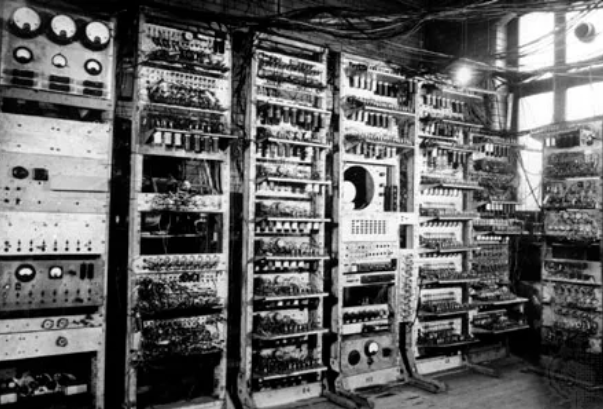
The evolution of computers illustrates a remarkable journey from the monumental ENIAC to today’s cutting-edge supercomputers. Each phase brought significant advancements that reshaped society, influenced industries, and enhanced technological capabilities. The transition from bulky machines to personal devices marked a pivotal change in everyday life. Yet, as supercomputers expand their role in research and artificial intelligence, questions arise about their future impact and the ethical considerations that accompany such rapid progress.
The Birth of Electronic Computing: ENIAC and Its Legacy
The Electronic Numerical Integrator and Computer (ENIAC), completed in 1945, stands as a pivotal milestone in the evolution of computing technology.
Its significance lies in pioneering the use of electronic components for complex calculations, drastically reducing processing time compared to mechanical predecessors.
This groundbreaking innovation laid the foundation for future advancements, ultimately influencing modern computing paradigms and the development of subsequent electronic devices.
See also: greennewsdesk
The Rise of Personal Computers: Transforming Home and Office
As technology advanced, the emergence of personal computers in the late 1970s and early 1980s revolutionized both home and office environments.
This innovation in home technology enabled individuals to manage personal tasks more efficiently, while simultaneously driving office automation, streamlining workflows, and enhancing productivity.
The personal computer became a vital tool, fostering independence and reshaping the dynamics of work and leisure.
The Internet Revolution: Connecting the World
With the advent of the Internet in the late 20th century, a transformative wave of connectivity emerged, fundamentally altering how people interacted and shared information across the globe.
Internet accessibility became a crucial factor in promoting digital communication, enabling individuals to bridge geographical divides.
This shift empowered diverse voices, fostering collaboration and innovation, while also raising questions about privacy, security, and the digital divide.
The Era of Supercomputers: Powering Advanced Research and AI
Emerging from the interconnected landscape fostered by the Internet, supercomputers have become pivotal in advancing research and artificial intelligence (AI). Their immense processing power facilitates breakthroughs in machine learning algorithms, enabling complex data analysis and predictive modeling.
Additionally, the integration of quantum computing promises to revolutionize computational capabilities, unlocking new potential in fields ranging from climate science to personalized medicine, fostering innovation and exploration.
Conclusion
The history of computers is akin to a vast, intricate tapestry, each thread representing a pivotal innovation. The invention of ENIAC set the foundation, akin to the first stroke of a painter’s brush, sparking a revolution that would transform the canvas of human experience. As personal computers emerged, they democratized access to technology, while the Internet interwove global connections. Today’s supercomputers stand as monumental towers in this landscape, enabling breakthroughs that will shape the future, much like the enduring legacy of art itself.