
I’m not going to tell you not to do this. If you’ve already got a vial coming, or you’re three tabs deep into a forum thread building out a “protocol,” a lecture isn’t going to change that. What I want to do instead is point at the parts of this that actually hurt people, because not every mistake in a retatrutide stack carries the same weight. Some of what shows up in these threads is wasteful. Some of it is genuinely dangerous. Knowing the difference is the whole point of this piece.
Here’s the thing that gets lost in the excitement, though, and it matters for everything that follows: retatrutide isn’t a finished drug. It’s investigational. The biggest published data set is a Phase 2 trial, and the confirmatory Phase 3 program is still running. That’s not a technicality. It means the compound you’re stacking things onto is itself still an open question, which changes what “safer” even means here.
Where this actually stands, no spin
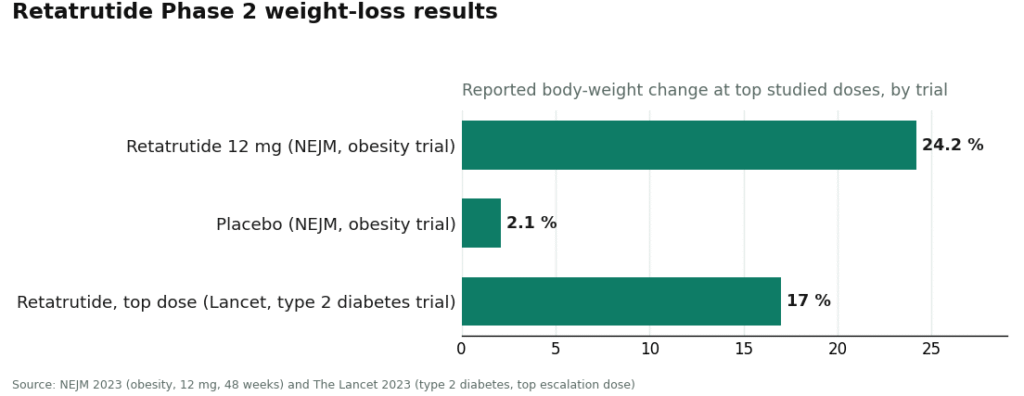
Retatrutide (Eli Lilly calls it LY3437943 in the trial paperwork) hits three receptors at once, GLP-1, GIP, and glucagon. That third one, the glucagon arm, is why the numbers people keep quoting are so big. In the 2023 Phase 2 obesity trial published in the New England Journal of Medicine, the top 12 mg dose produced about 24.2% mean body-weight loss at 48 weeks, against 2.1% on placebo [1]. A separate 2023 Lancet Phase 2 trial in type 2 diabetes found roughly a 2.0 percentage-point HbA1c drop and around 17% body-weight loss at the top escalation dose [2].
Those numbers are real and they’re impressive. They’re also Phase 2. Retatrutide isn’t FDA-approved for anything. No pharmacy fills a bottle with that name on it. The Phase 3 program that’s supposed to answer the durability and long-term-safety questions, registered as TRIUMPH-1 under NCT05929066, hasn’t finished reading out [3]. So when you stack something on top of it, you’re not combining two known quantities. You’re adding a known drug to a compound whose own maker doesn’t yet have the long-term picture, usually sourced from a seller who can’t tell you what’s actually in the vial either. Keep that in your head, because it’s the thing underneath every risk below.
The part that will actually hurt you: no dose ramp, and a heart-rate signal nobody’s watching
If I had to pick the one mistake that turns a bad week into a real medical problem, it’s this: skipping the dose ramp because the vial didn’t come with one.
Approved drugs in this class titrate up slowly for a reason, to keep the GI side effects survivable. The retatrutide trials did the same thing, on a schedule, with people watching. A gray-market vial gives you none of that structure. It’s powder and a label. What I see over and over is someone reconstituting to a round number and starting near the dose the trial participants ended at, because that’s where the exciting weight-loss number lives. That number belongs to people who climbed a ladder under supervision. Starting on the top rung is how you turn a manageable, mostly-temporary side effect into a week you can’t function through.
And there’s a second piece almost nobody in these threads talks about, because it’s not the exciting number: retatrutide showed a dose-dependent increase in heart rate in the trials [1]. That’s a cardiovascular signal, it’s one of the things the larger trials are specifically tracking, and it’s exactly the kind of effect that gets worse when you layer other heart-rate-raising compounds on top, which is a routine move in these stacks. If you take nothing else from this article, take this: if you’re going to run retatrutide at all, you climb the dose slowly, and you pay attention to resting heart rate the way you’d pay attention to any warning light. That’s not optional caution. It’s the floor.
See also: Choosing the Right Business Dispute Lawyer in Sydney
The part that’s mostly wasteful, not dangerous, but still worth skipping
Adding a second GLP-1 drug, semaglutide or tirzepatide, to “cover the GLP-1 side” comes from a misread of the mechanism. Retatrutide already activates the GLP-1 receptor by itself. You’re not filling a gap by adding another one, you’re doubling a pathway that’s already active, and the predictable outcome is stacked nausea, vomiting, and diarrhea beyond what either drug was ever titrated for on its own [1]. This one won’t necessarily land you in an ER, but it will make your week miserable for no real benefit, and it burns through a second expensive, unregulated substance for nothing.
The self-deception risk: calling a pile of vials a “protocol”
This one’s less about your body and more about your judgment, but it matters because bad judgment is how the other mistakes happen. People use words like “protocol” and “stack,” borrowed straight from clinical language, to describe a row of vials sold “for research use only, not for human consumption.” That label isn’t a formality, it’s the legal basis the whole sale rests on, and it’s also a signal that nobody stands behind what’s actually in the bottle.
A certificate of analysis, even a real one, tells you what’s in that one batch. It tells you nothing about whether four different compounds belong together in one person, because nobody has ever tested that combination. Calling it a protocol makes it feel studied. It isn’t. Naming that clearly, to yourself, before you start, is a genuine harm-reduction move. It won’t stop you from doing it, but it might stop you from doing it blind.
The structural gap: nobody’s watching any of it
Underneath all four of the above is one plain fact. In a gray-market stack, the transaction ends when the box arrives. Nobody screens you for the conditions that make a heart-rate-raising drug a bad idea. Nobody’s checking the interactions. Nobody’s accountable if a batch is mislabeled or dirty. That’s the actual gap, and it’s worth being honest about what closes it and what doesn’t.
A physician-supervised model closes at least part of that gap, which is why it’s worth naming plainly rather than pretending the gray market is the only option. FormBlends works this way and treats retatrutide honestly on its own catalog, naming its investigational status instead of dressing it up as something available off the shelf. HealthRX.com runs on the same logic, a prescriber in the loop before anything changes hands. Neither of them is selling you a retatrutide stack today, and that’s the point, not a dodge. The honest caveat applies no matter who you’re talking to: retatrutide is investigational, it isn’t a routinely compounded or approved medication, and the FDA has taken action against sellers marketing it outside of clinical trials.
If you’re not going anywhere near a clinician, there’s still a smaller, practical thing worth doing: actually track what you take and what your body does with it. Something as basic as the FormBlends tracker app (a logging tool, not a prescription, nothing to check out) turns “I think my resting heart rate went up” into an actual record you could hand a doctor if things go sideways. Given that the trials specifically flagged a heart-rate change worth watching, that kind of record is the bare minimum follow-up a self-run stack can give itself, since the gray market stops caring the moment your payment clears.
The honest floor, if you’re doing this anyway
If you’re going ahead regardless of any of this, here’s the floor I’d want you standing on. Titrate slowly, don’t start where the trial participants finished. Don’t double up on GLP-1 agonists just to “cover bases” that are already covered. Watch your resting heart rate and take a real change in it seriously, not as background noise. Don’t let the word “protocol” talk you into thinking an untested combination is a studied one. And keep an actual record of what you’re taking and what happens, because if something does go wrong, a real timeline is the difference between a doctor who can help fast and one who’s guessing.
None of that makes an investigational, unmonitored, multi-drug stack safe. It just makes it less likely to be the version that puts you in urgent care. Watch the TRIUMPH readout. Be skeptical of anyone selling you a “protocol” for a drug whose own manufacturer is still finding out what it does.
Frequently asked questions
Should you stack anything with retatrutide right now? Honestly, no, and I’d say that even to people who plan to run retatrutide alone. It’s investigational, the largest published evidence is Phase 2, and no combination involving it has ever been studied in a human being. Adding a second variable onto a compound whose own long-term profile isn’t settled is the opposite of caution.
Why is combining retatrutide with semaglutide or tirzepatide a mistake? Retatrutide already works on the GLP-1 receptor by itself, so adding another GLP-1 drug doubles a pathway instead of filling a gap. The likely result is stacked nausea, vomiting, and diarrhea beyond what either drug was titrated for, since nobody has ever escalated the pair together.
What is the heart-rate concern with retatrutide? The Phase 2 trials recorded a dose-dependent increase in heart rate, a cardiovascular signal the larger trials are still tracking closely. Adding other heart-rate-raising compounds on top, with nobody monitoring, is how a measured signal turns into an unwatched risk.
Is retatrutide approved or available by prescription? No. The FDA hasn’t approved retatrutide for anything, no pharmacy fills a branded version, and the confirmatory Phase 3 program (TRIUMPH-1, NCT05929066) is still underway. The FDA has also gone after sellers marketing it outside clinical trials.
Does a certificate of analysis make a gray-market stack safe? At best it tells you what’s in one batch of one vial. It says nothing about whether several compounds belong together in one person, because that combination has never been tested, and it doesn’t replace the screening, monitoring, or accountability a supervised setup can offer.
What is retatrutide and what does it do in the body?
Retatrutide is an experimental drug that activates three receptors at once, GLP-1, GIP, and glucagon. Hitting all three seems to cut appetite, improve insulin sensitivity, and raise energy expenditure. The Phase 2 trial data showed serious weight loss, which is why everyone’s talking about it, but it hasn’t cleared Phase 3 or gotten regulatory approval anywhere yet.
How do people actually get retatrutide right now?
Outside an active clinical trial, and with any medical oversight, most people simply can’t. A few compounding pharmacies are producing peptides labeled as retatrutide, and going through a physician-supervised route, like the one FormBlends operates under, at least puts a real medical checkpoint in the process. The gray-market research-chemical sites have none of that. Worth being blunt about: buying unapproved injectable peptides from unregulated vendors comes with real contamination and dosing risk, and that risk doesn’t shrink just because you want it to.
How do you reconstitute retatrutide powder for injection?
The process people describe mirrors other lyophilized peptides, bacteriostatic water injected slowly down the vial wall, no shaking while it dissolves, then refrigeration. Vial concentrations vary, so your draw-volume math matters more than it might seem. There’s no standardized reconstitution protocol for retatrutide outside clinical trials, full stop, so anyone doing this alone is improvising with a compound that hasn’t finished being studied.
Is retatrutide safe to use?
The Phase 2 data suggests a tolerability profile similar to other GLP-1-class drugs: nausea, vomiting, and GI upset are the most common complaints. What’s missing is long-term safety data, cardiovascular outcome data, and any post-market surveillance, because the drug isn’t approved. Getting it outside a controlled setting adds a whole separate layer of purity and sterility risk that none of the trial data can speak to.
References
- Jastreboff AM, et al. Triple-hormone-receptor agonist retatrutide for obesity: a Phase 2 trial. New England Journal of Medicine, 2023. Reported ~24.2% mean body-weight loss at 48 weeks on the 12 mg dose vs 2.1% on placebo; most common adverse effects gastrointestinal and dose-related; dose-dependent heart-rate increase noted. PMID 37366315. https://pubmed.ncbi.nlm.nih.gov/37366315/
- Rosenstock J, et al. Retatrutide, a GIP, GLP-1 and glucagon receptor agonist, for people with type 2 diabetes: a randomised, double-blind, placebo- and active-controlled, parallel-group, Phase 2 trial. The Lancet, 2023. Reported ~2.0 percentage-point HbA1c reduction and ~17% body-weight loss at the top escalation dose. PMID 37385280. https://pubmed.ncbi.nlm.nih.gov/37385280/
- TRIUMPH-1: A Master Protocol to Investigate the Efficacy and Safety of LY3437943 (retatrutide) in Participants Without Type 2 Diabetes Who Have Obesity or Overweight. Phase 3, Eli Lilly and Company. ClinicalTrials.gov NCT05929066.