Each year, thousands of international and Indian students choose to attend medical school in Russia to obtain a medical degree recognized by bodies like the National Medical Commission (subject to eligibility requirements). In addition to enjoying a high-quality education that is recognized around the globe, structured curriculum aligned with national medical education standards.
While there are many reasons to study at a Russian medical school, one of the aspects that sets Russian medical schools apart from schools in other countries is their unique and rigorous approach to teaching and learning. If you’re planning on studying medicine outside your country, you should consider how medical schools in Russia teach.
A Curriculum Built on Strong Foundations
In Russia, the MBBS program is a 6-year program that is divided into two parts: the theoretical phase and the clinical phase of the program. During the first 3–4 years, focus on pre-clinical and para-clinical subjects education (e.g., Anatomy, Physiology, Biochemistry, Histology, and Pathology).
Medical schools in Russia tend to take a very structured approach to the education of future physicians. While some countries place a heavy emphasis on self-directed learning, a Russian medical school places a heavy focus on structured, traditional lecture styles that include compulsory attendance at lectures and other teaching sessions. Students are expected to participate in lectures, practical sessions, and seminars in a disciplined manner. In Russian medical schools, attendance is compulsory, and students are not allowed to miss a significant number of lecture hours.
Lecture-Based and Seminar-Driven Learning
One feature that separates Russian MBBS courses from those offered elsewhere is that most of the teaching occurs through lectures, which are delivered by professors who are primarily practicing doctors or researchers and who provide lecture presentations that are very substantive in nature, having been developed over many years of research and practice.
Equally important to the student’s educational experience are the seminar classes. During these classes, students are required to be on time and to have reviewed the material before each class. Students are then expected to provide presentations about various topics or clinical scenarios and to answer questions posed by other students and faculty members. Participating in seminars provides students with the ability to critically analyze and develop confidence in specific academic disciplines from the first week they enter the program. Students who are used to rote learning often find these classes somewhat intimidating initially; however, after only a short period of time, the majority of students adapt to this system and appreciate the additional depth it adds to the knowledge they gain.
Practical and Laboratory Training
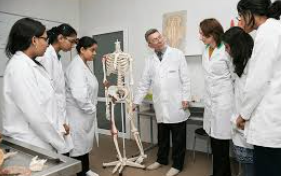
Another significant aspect of the Russian medical education program is that most of the students’ time is spent working in laboratories or performing hands-on experiences in the clinical setting from the first year forward. Students are involved in laboratories performing experiments throughout their academic training, and they are frequently studying various specimen types on a regular basis. In addition to the above-listed activities, the majority of the first and second years of the students’ academic careers are spent on practical activities in the areas of anatomy, histology, and biochemistry.
Thus, when clinical rotations commence, the majority of students have had ample experience in a clinical and laboratory environment.
Clinical Training in the Later Years
Clinical rotations typically begin in the later years (around 4th year onwards) through various clinical rotations and will do so at different hospitals across various specialties—General Surgery, Obstetrics & Gynaecology, Paediatrics, General Medicine, etc.—for clinical practice, etc.
Russian universities are usually affiliated with large government hospitals where students gain valuable experience treating a high volume of patients experiencing a wide range of ailments. This is one of the major benefits of completing your MBBS in Russia; many students choose to study at these institutions because they provide a good quality of education and many places to learn.
Spotlight: Immanuel Kant Baltic Federal University
Among many other NMC-recognized Russian universities, Immanuel Kant Baltic Federal University (IKBFU), located in Kaliningrad, is a promising option for students wishing to seek an NMC-recognized degree while studying at a university set up in Kaliningrad.
Immanuel Kant Baltic Federal University (IKBFU) is committed to providing an innovative, forward-thinking approach to medical education; its holistic approach combines traditional Russian methods (e.g., academic rigor, small class sizes for individualized learning, and maximum attention from faculty) with modern technological advancements (e.g., simulation labs, e-learning, and problem-based learning).
Language of Instruction
Many Russian medical universities offer English-medium programs in the initial years as a medium of instruction to students in the early years of their MBBS program, as many international students participate in this program. As students advance, they will also gradually become immersed in the Russian language for the purposes of communicating with patients during their clinical placements.
Russian Language classes are included in the student curriculum from Year One so that by the commencement of their clinical training, students will possess adequate skills to effectively communicate with patients.
Assessment and Examination System
Universities in Russia are subject to an extremely rigorous grading and evaluation system. Students will not only have to take regular internal tests, semester-long examinations, and practical viva evaluations, but they will also be required to maintain a passing course mark in each course to advance to their next academic year.
This constant evaluation method may prove to be very demanding and overwhelming; however, this ensures that students will develop a thorough understanding of both theoretical and practical knowledge of each subject rather than simply completing the requirements of the program.
Why Students Trust EOCL India for MBBS Abroad ?
Students wanting to study abroad often find the number of options available overwhelming, so they have issues securing admission and transitioning into their new country. EOCL assists students with the selection of universities, admission, visa application processes, and post-arrival support, thereby providing a comfortable transition to their new environment as doctors. With a focus on delivery of quality services, trusted providers, and student success, EOCL aims to make the entire MBBS abroad process simple, safe, and successful for students. Contact EOCL India today!
See also: Top 7 Ways Real Estate Agents Are Using Agentic AI to Generate More Leads in 2026
FAQs About Teaching Methods in Russia Medical Colleges
Which type of teaching does the university offer for MBBS courses?
This is a combination of lectures with practical and clinical placements.
Is there enough exposure to practicals with the MBBS course?
Absolutely, students will undergo hospital and laboratory experiences both early on in their studies and throughout the duration of their studies.
Does the university apply modern-day teaching methods?
Yes, they incorporate the use of digital technologies and simulation-based learning techniques into their curriculum.
Is MBBS in Russia taught in English?
Many schools have English-language programs available.
Are students assessed regularly?
Students are evaluated by way of: Testing (exams), practical exams, and ongoing assessments conducted by each department.